E Invoicing Deployment in Fuel Retail: Architecture, Governance, and Best Practices
E‑invoicing refers to the digital generation, transmission, and validation of invoices in standardized formats. In the fuel retail sector, it ensures that every fuel sales transaction is recorded, reported, and auditable in real time.
Gas stations face unique challenges: high transaction volumes, integration with fuel dispensers, and the need for very smooth customer experiences.
Role of Government #
Governments play a central role in how e invoicing works at fuel stations. On one hand, they act as regulators by making electronic invoicing mandatory for every fuel sale, ensuring that transactions are properly recorded and reported. They also set the standards by defining the structure of invoices, the rules for validation, and how often businesses must submit reports. Beyond regulation, governments serve as monitors, using real time access to sales data to detect irregularities and prevent tax evasion.
Architecture of E Invoicing at Gas Station #
The e-invoicing system at filling stations usually has four main parts.
The first part is the point of sale (POS), where fuel dispensers and cash registers are connected to invoicing software so that every sale is recorded automatically.
The second part is the middle layer, which prepares invoices and manages document exchange.
The third part is the government gateway, which provides secure channels to send invoices directly to tax authorities for checking and approval.
The fourth part is data storage and analytics, which keep records in one place for audits, reporting, and detecting fraud.
This setup ensures that each fuel sale is tracked from the pump to the government database without manual intervention.
Approaches to E Invoicing in Fuel Retail #
Global practices in e invoicing show different approaches to the same challenge: ensuring that fuel sales are transparent and properly reported.
Pre authorization model
Every fuel sale must be reported to the tax authority before the customer receives the invoice. This guarantees strict compliance and transparency, but it requires strong IT infrastructure and can be difficult for smaller businesses.
Intermediary platform model
Gas stations generate invoices in their own systems, but these must pass through a government platform before being finalized. This approach combines regulatory control with operational flexibility, enabling integration with existing business tools. The trade off is added complexity and the need for coordination between systems.
Direct reporting model
Filling stations connect directly to the tax authority’s platform, and transactions are reported instantly. This reduces tax evasion and simplifies reporting, but it limits customization and flexibility for businesses.
Despite differences in execution, the common principle is that governments require certification or direct approval of e invoicing systems. Some models emphasize centralization, others blend control with flexibility, and others enforce real time control. In all cases, government involvement is the key to compliance in fuel retail.
Best Practice Recommendation #
The Intermediary platform model is widely considered the most effective approach for fuel stations. In this setup, the government provides standardized connections to ensure compliance, while businesses retain the flexibility to manage their own operations. This model also grants fuel retailers the freedom to choose the e invoicing software provider that best fits their needs, or even to develop their own solution in house.
This approach also brings clear benefits in terms of automation. Stations can issue invoices quickly and accurately, reducing manual work and minimizing errors. At the same time, they remain fully audit ready, since all transactions are securely stored and accessible for reporting.
How PTS 2 Forecourt Controller Enables E Invoicing Across All Models #
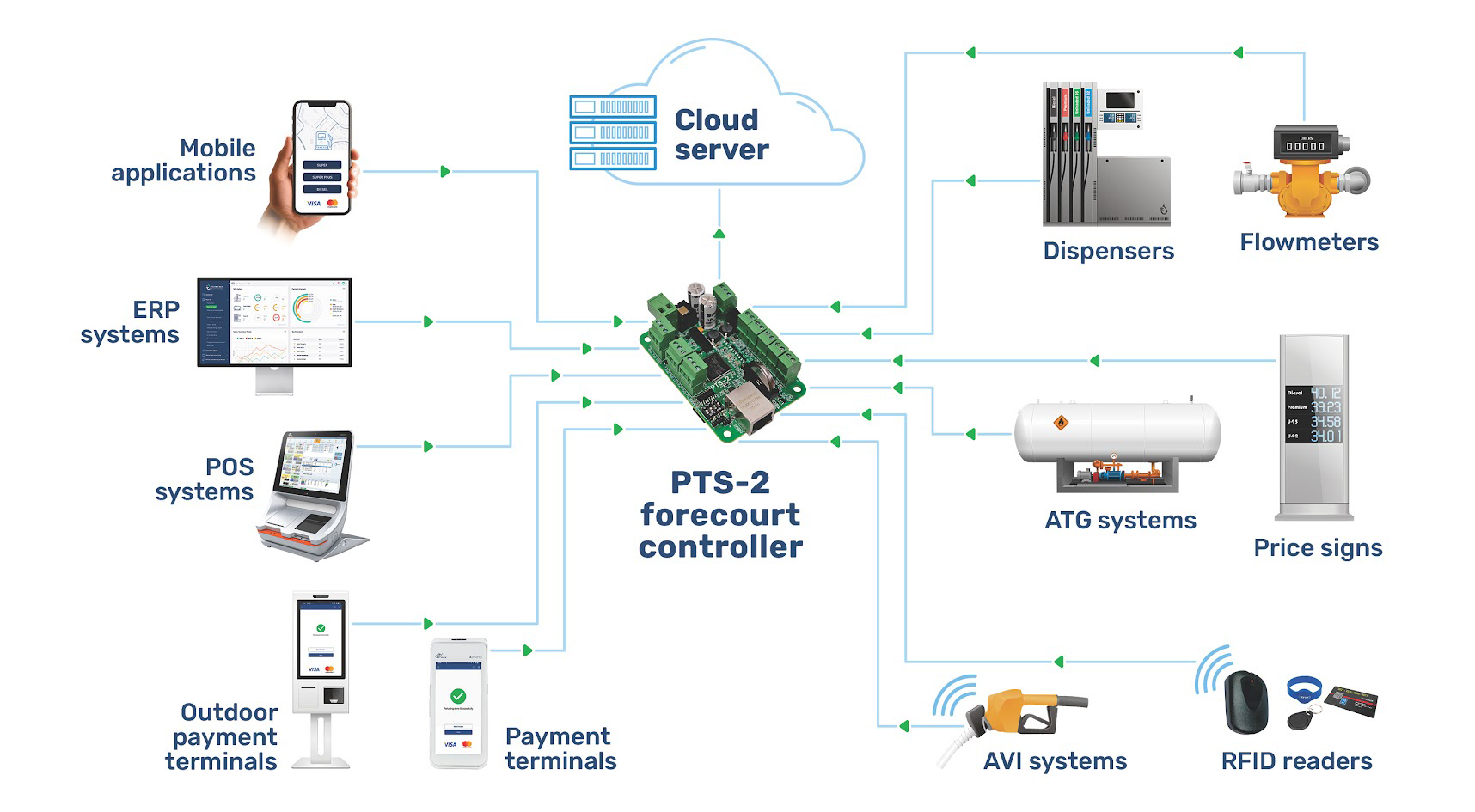
The PTS-2 forecourt controller makes e‑invoicing possible at any filling station, no matter which system is used. It supports more than 160 fuel dispenser brands, meaning every dispenser can be fiscalized.
The PTS-2 controller connects easily with local POS systems through its own protocol or communicates with remote servers in real time using HTTPS or WebSocket.
An open API allows simple integration with third‑party software, making it adaptable to different government or ERP platforms.
Wireless communication with dispensers removes the need for trenching, reducing installation costs. Inbuilt memory stores transactions even when the station is offline, ensuring no sales are missed.
Whether you are a government authority that must enforce compliance or an integrator tasked with connecting local invoicing systems, the PTS-2 controller ensures compatibility with any dispenser in the field.
Contact us to discuss how your solution can be seamlessly integrated and made fully compliant.
With the PTS-2 forecourt controller integration takes just 3–8 weeks—fast enough to meet regulations and keep clients compliant.