Fair Delivery - system for control over fuel deliveries from oil depots to gas stations with analysis of fuel thefts and losses
PROBLEM
According to Worldmetrics (https://worldmetrics.org/fuel-theft-statistics), annual global losses from fuel theft amount to around 100 billion USD. In Nigeria, fuel theft costs the economy 3 billion USD each year. The level of economic development does not reduce the scale of the problem - statistics from the United States and Europe confirm this: American fuel freight transport loses 2,5 billion USD annually due to theft, while European Union member states suffer losses of 5 billion EUR per year.
The statistics confirm: fuel theft is a global problem, marked by scale and sophistication. The most common method is fuel siphoning, accounting for 40% of cases. Fuel tanker trucks are involved in 60% of all incidents (for example, in Kenya, 80% of thefts are linked to siphoning fuel from delivery trucks). In 18% of cases, fake fuel tanks and specialized siphoning devices are used. The average volume of stolen fuel in a single incident reaches 5,000 liters.
SOLUTION
Technotrade has developed the Fair Delivery concept, focused on fuel tanker trucks - the key link in transporting fuel from oil depots to filling stations. The method ensures full control: the volume loaded at the depot must match the volume delivered to the station.
From Depot to Filling Station: Liter for Liter
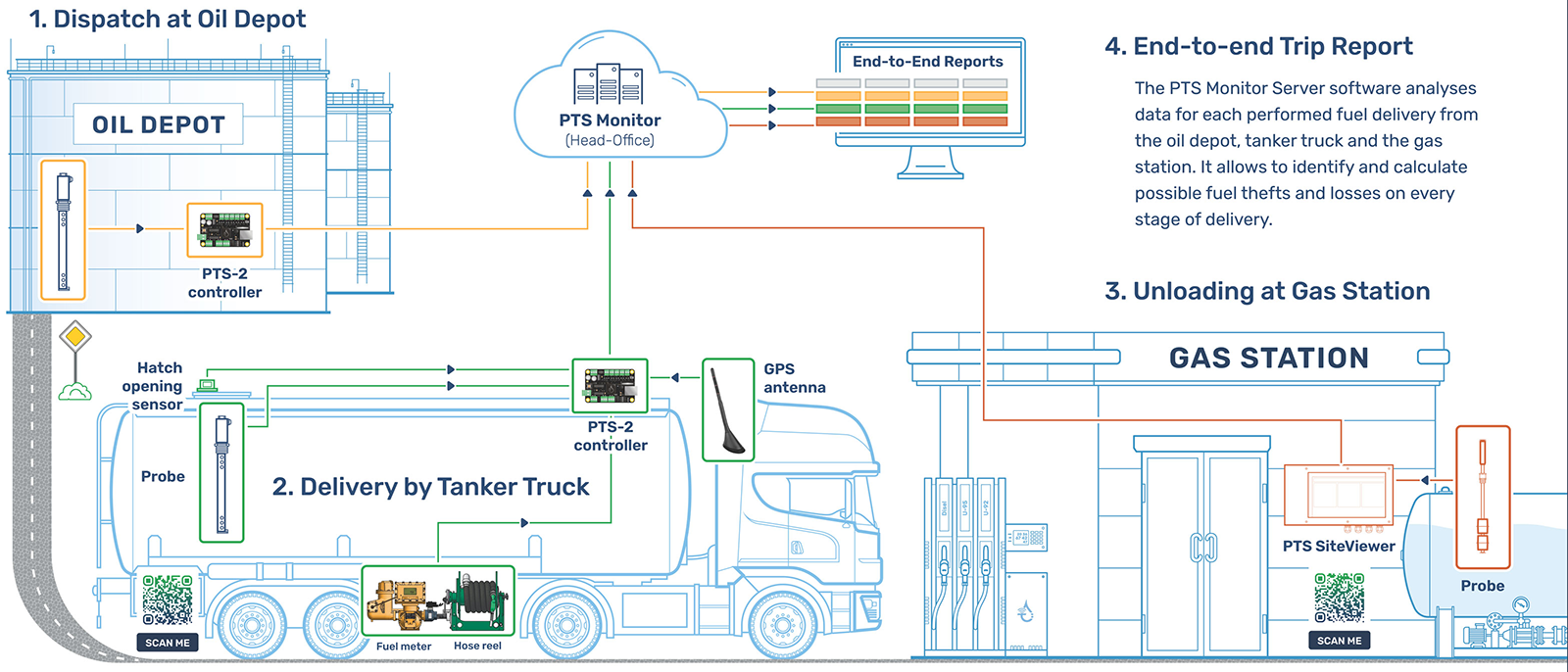
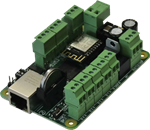
The “Fair Delivery” fuel monitoring system is implemented through the installation of specialized equipment at all key stages of transportation - from the oil depot to the filling station. At the depot, a PTS-2 controller is installed, along with tank level gauges (ATG) that record the exact volume of fuel loaded.
On the tanker truck, a dedicated PTS-2 controller with GPS tracking is mounted, together with tank level gauges in each compartment of the tank and hatch-opening sensors. This setup provides complete control over the transportation process: any change in fuel levels within the compartments, as well as hatch openings, are recorded with precise time and geolocation data.
At the gas station, the system is complemented by the PTS-2 controller and ATG probes, enabling verification of the actual volume of fuel received against the data from the depot and the tanker.
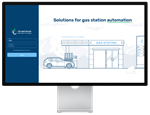
The PTS Monitor Server software receives data from the PTS-2 controllers and analyses data for each performed fuel delivery from the oil depot, tanker truck and the gas station. It allows to identify and calculate possible fuel thefts and losses on every stage of delivery and provide information on them in a view of detailed reports.End-to-End Fuel Movement Control: Identifying Responsibility for Shortages
At the end of each tanker truck trip, a detailed report is generated, consolidating data from all stages of fuel transportation.
At the oil depot, the PTS-2 controller records the volume of fuel loaded into the tanker’s compartments, along with operator data reflected in the transport waybill. The report also includes readings from the PTS-2 controller installed on the fuel delivery tanker truck, confirming fuel levels in the compartments immediately after loading.
During transit, the system continuously monitors fuel levels in the compartments and tracks the actual route of the vehicle. The report displays the coordinates of all stops where siphoning occurred.
At the filling station, the PTS-2 forecourt controller records the fuel levels in the tanker compartments and the actual volume discharged through the flowmeter (if unloading is managed by the PTS-2 controller system). Simultaneously, the report incorporates data from the station’s fuel management system and operator: the volume measured by tank level gauges, as well as the accepted quantity documented in the waybill or tank calibration table.
Thus, the end-to-end report enables cross-checking of data from the depot, the tanker truck, and the gas station. Based on this information, the PTS Monitor Server software is able to accurately determine at which stage and by whose fault discrepancies in fuel volumes occurred, whether due to the depot operator, the tanker driver, or the station operator.
Fair Delivery Begins with Tanker Truck Control
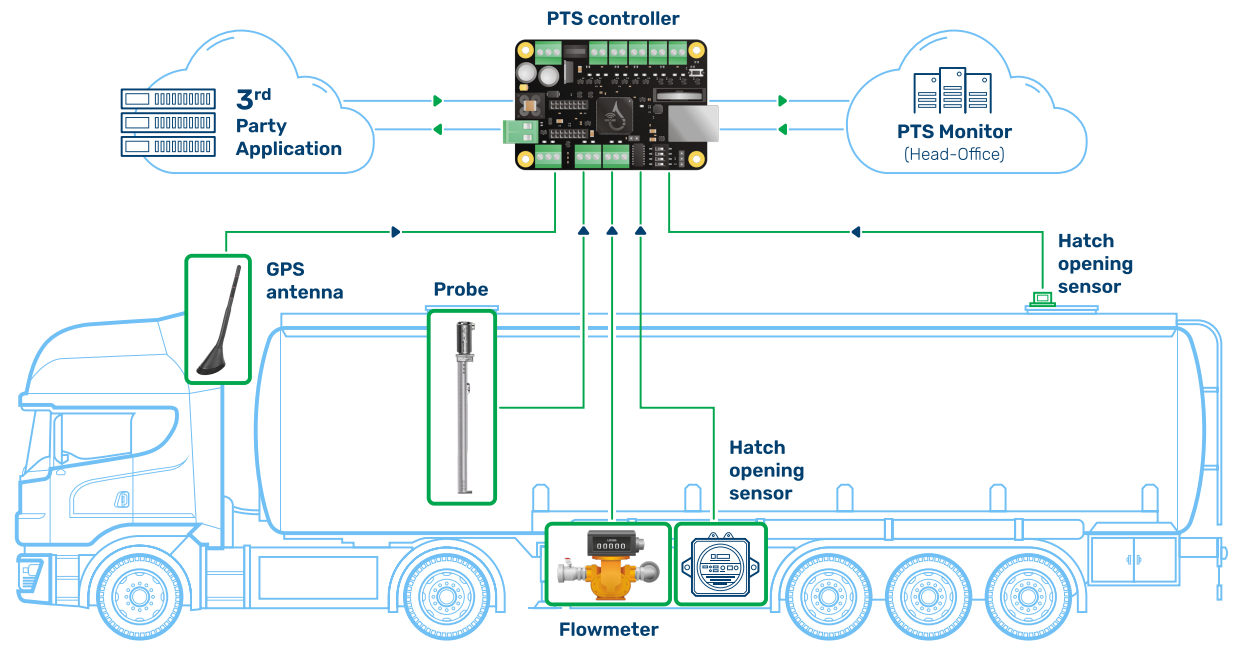
What if one of the participants in the fuel supply chain is interested in maintaining the status quo?
The fight against theft can start with the main risk - putting the tanker truck under full control. At the oil depot, data on tanker loading is recorded by the depot operator, while at the fuel station, information on fuel reception is logged by the station operator.
On the tanker truck, equipment is installed to ensure automatic monitoring: a PTS-2 controller with GPS tracking, compartment level gauges, and hatch-opening sensors. These devices allow tracking of fuel volume, its movement, and all operations with the tank without human intervention.
Thus, the system combines manual data entry at the depot and fuel station with automatic control on the tanker truck, ensuring transparency and enabling the detection of possible discrepancies in the fuel transportation process.
How is fuel delivery controlled?
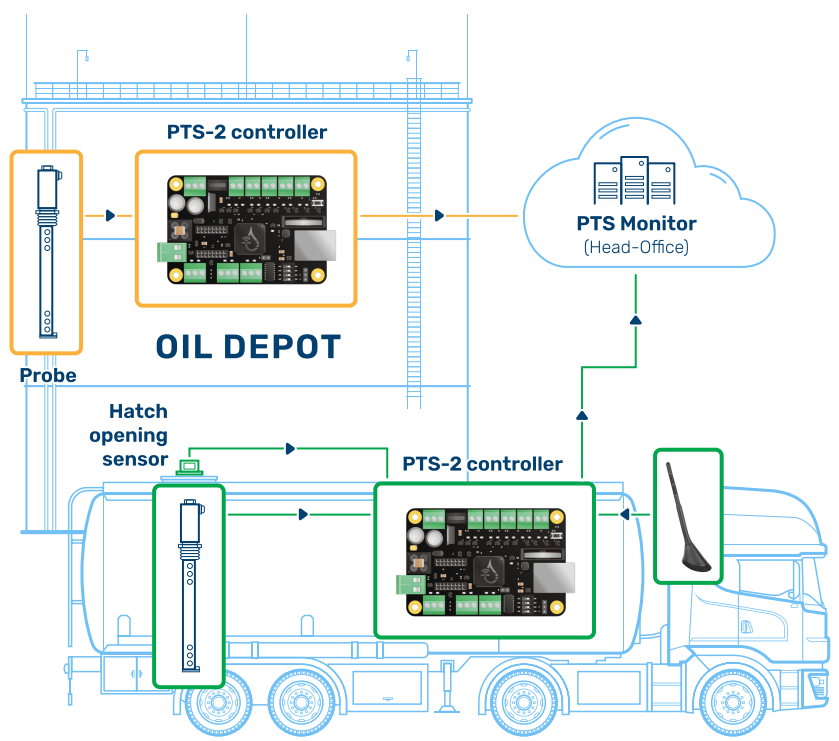
Stage 1 – Fuel Dispatch
- The PTS-2 controller at the oil depot records the volume of fuel dispatched and transmits this data to PTS Monitor Server
- Simultaneously, the PTS-2 controller on the fuel tanker records the volume of fuel received and also transmits this data to PTS Monitor Server
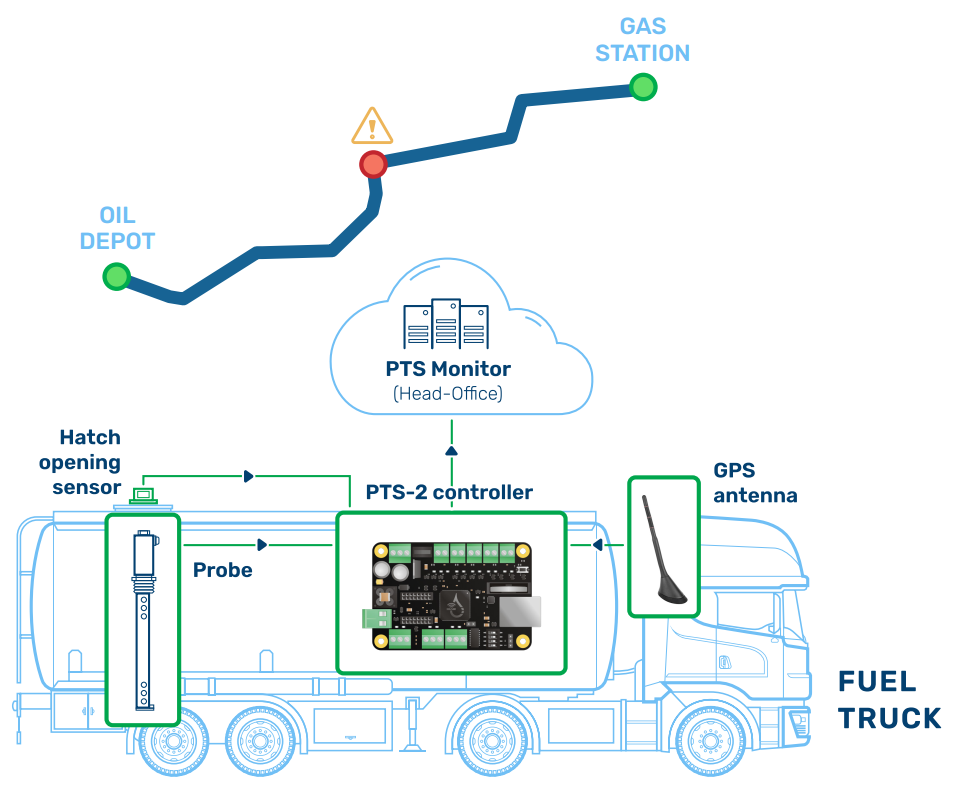
Stage 2 – Delivery
- The PTS-2 controller installed on the fuel tanker uses a GPS transmitter to track stops along the route, monitor fuel levels, and control hatch opening sensors
- All recorded changes are transmitted to the PTS Monitor Server
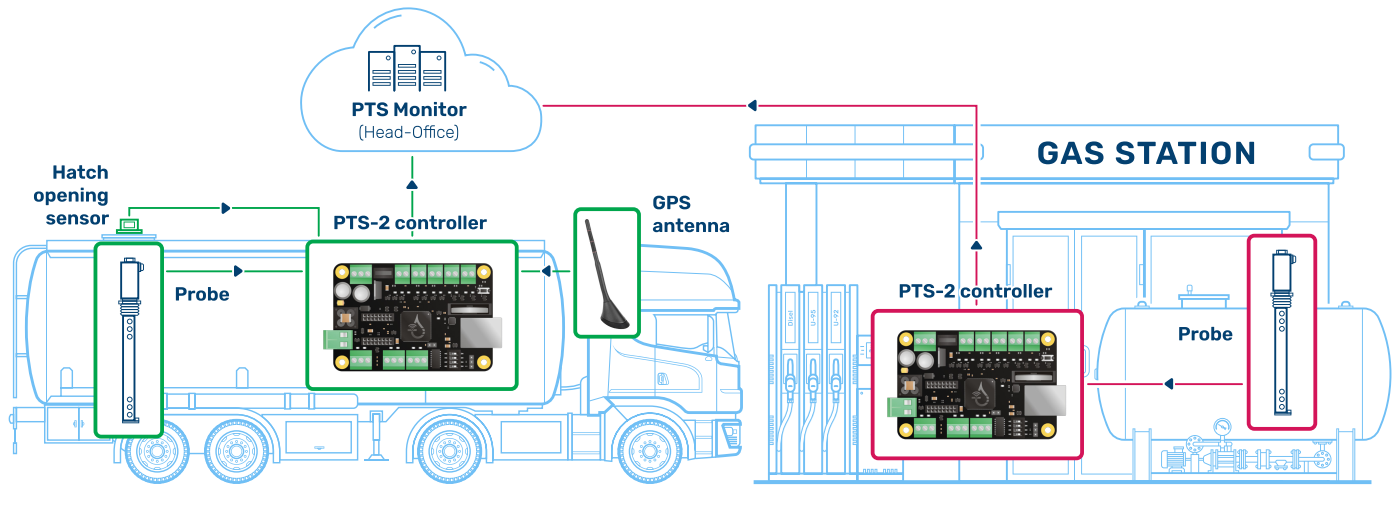
Stage 3 – Fuel unloading
- The PTS-2 controller on the tanker truck records the volume of fuel dispensed and sends this information to PTS Monitor Server
- The PTS-2 controller at the gas station records the volume of fuel delivered and its level in the storage tank, and transmits this data to PTS Monitor Server
Stage 4 – Comparing data for fuel losses
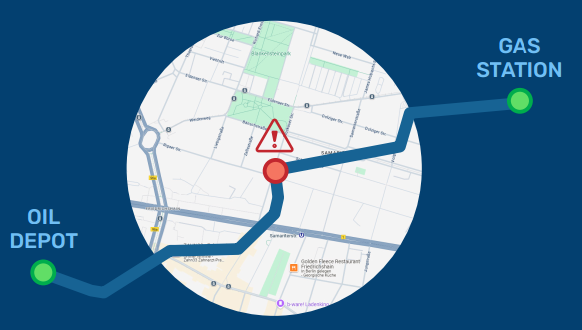
- The PTS Monitor Server generates first report, which shows at which stage of the delivery and in what quantity the loss occurred

- The PTS Monitor Server generates second report, which indicates the exact location on the map, where the fuel loss occurred
What Results Can Be Expected from the System?
Until now, fuel control solutions have been implemented by different providers in a fragmented way, without a single integrated system.
According to available statistical data (https://worldmetrics.org/fuel-theft-statistics/), the introduction of individual fuel control measures in various countries has shown a significant reduction in theft cases. For example, equipping 80% of the U.S. vehicle fleet with GPS trackers reduced fuel theft by 60%. In Nigeria, the use of fuel tank locking systems decreased theft by 45%. In Australia, the installation of automatic tank gauges (ATG) at fuel stations reduced incidents by 30%.
Globally, the implementation of fuel delivery management software has helped reduce errors and theft by approximately 30%.
These examples confirm that even isolated measures deliver noticeable results. A comprehensive system, integrating control at the depot, tanker, and filling station into a single chain, can provide an even higher level of transparency and security in fuel supply.
Ready to Discuss a Tailored Solution for Your Company?
Technotrade is a global provider of automation and fuel management solutions for filling stations, oil depots, and vehicle fleets. Since 1993, Technotrade has successfully automated more than 30,000 fuel stations in over 140 countries worldwide.
CONTACT US to develop the optimal solution specifically for your business!
Products in structure of this solution:
|
PTS Monitor server software
The PTS Monitor server is designed for collecting reporting and real-time data from the PTS-2 forecourt controllers and other necessary information about the operation of the forecourt equipment of the gas station network, where the PTS-2 forecourt controllers are used for control over equipment.