Automatic tanks calibration powered by the PTS-2 forecourt controller
Solution #
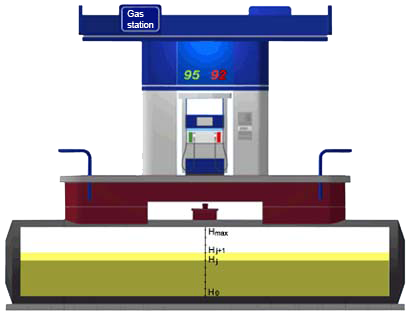
Fuel accounting at gas stations is one of the key operational concerns. A crucial element in this process is the calibration tables of fuel tanks, which are used for receiving fuel from tank trucks, dispensing fuel to customers using dispensers and monitoring current fuel levels. The calibration table allows determining the volume of fuel in the tank based on the fuel level measured by a level sensor installed in the tank.
At petrol stations horizontal cylindrical steel tanks are used to store petroleum products. The tank is a measuring instrument that has a calibration table compiled during its manufacture process. The calibration chart is a document, which stores correspondence between the fuel height in tank and its volume. The tank calibration chart is used for calculation of the fuel volume remains in tanks, in-tank deliveries registration, temperature-compensated volume calculation, others.
During operation tanks tend to change their parameters due to various types of deformations and external influences: this may be deformation of the body of the tank, tank tilt, foreign objects entering the tank, etc. Therefore, during operation of the tank the initial calibration chart of the tank becomes more and more different from its real calibration chart. The discrepancy between the actual calibration chart and the initial chart, which was provided from the factory at tank supply, leads to the loss of real accounting of the movement of petroleum products. It leads to a necessity to provide periodically tank recalibration in order to prepare a new actual calibration chart, which corresponds to present tank state.
Why do we need to calibrate our tanks periodically?
Fuel tank calibration at gas stations is essential for accuracy, safety and legal compliance. Here’s why it matters:
1. Accurate measurement of current fuel remains.
- During regular operation, the shape and geometry of the fuel tank may gradually change.
- Such changes will lead us to discrepancies in the original calibration table and inaccurate results in wet stock management.
- Periodic tank calibration ensures that the reading reflects the true volumes in our tanks.
2. Prevents financial loss.
- Without accurate calibration, a station may think it has more (or less) fuel than it really does. Such errors can lead to unexplained shortages or incorrect fuel reordering
3. Detecting leaks, frauds or contamination.
- Correct calibration helps more precisely identify underground tank leaks or frauds. Any discrepancy between expected and actual volume can trigger an investigation.
4. Legal and Regulatory Requirements.
- Most countries require calibration by law to ensure fair trade practices.
- Regulators periodically inspect fuel stations, and non-calibrated tanks can result in:
- Fines
- Shutdowns
- Loss of operating licenses
In short
We should calibrate fuel tanks to ensure accurate fuel measurement, prevent financial loss and meet legal requirements.
There are two main methods for creating calibration tables:
- Traditional method: filling/draining the tank with water using a reference flowmeter.
- Automatic calibration method: performed during station operation using level sensors and properly calibrated dispensers.
Since the traditional method is still in use, we would like to outline its main advantages and disadvantages. Advantage of the method is high accuracy - up to 0.5% error margin. However, achieving this level of accuracy required significant expenses and investments due to the following factors:
- Loss of profit due to the shutdown of the gas station during the work
- Calibration services are provided by specialized company
- Disposal of used water in accordance with environmental regulations
Traditional method of tank recalibration includes emptying of the tank from fuel and then a special procedure of filling and draining the tank with water. This procedure is quite costly because it requires a special equipment and also you need to stop the operations with the tank, which leads to stopping of the petrol station's operation.
Autocalibration (also called automatic tank calibration) is alternative calibration method, which provides several important advantages over traditional manual calibration.
Here are the key benefits:
1. Continuous monitoring (Not Just Once)
Traditional calibration is a one-time or periodic activity. Autocalibration runs 24/7, detecting even small deviations caused by:
- Temperature changes
- Tank deformation
- Fuel expansion/contraction
This keeps the calibration valid at all times. Accuracy of this method is sufficient for daily fuel inventory and operational reporting.
2. Saves time and operational costs
Manual calibration is slow and requires shutting down tanks and gas station.
Autocalibration:
- Runs in the background
- Requires no downtime
- Reduces the need for frequent manual recalibration
This increases uptime and reduces labor costs.
3. Reduces human error
Manual tank dipping and calibration are prone to mistakes due to:
- Incorrect dip readings
- Tanker delivery errors
- Calculation mistakes
Autocalibration eliminates most of these human factors.
4. Automatic calibration is also effective for detecting fuel theft by staff when combined with daily inventory and fuel dispenser monitoring (manual and automatic modes).
Here is the video explanation of this method:
In order to make this procedure to be simple and to keep your tanks to have the actual calibration chart without a need to stop the petrol station operation, we in Technotrade company added the tanks automatic calibration procedure directly in the PTS-2 forecourt controller.
The PTS-2 forecourt controller is able to perform tanks automatic calibration automatically without stopping the petrol station operation. The process is fully automated and each tank’s calibration chart is automatically calculated and adjusted in the process of the tank operations. For this process the PTS-2 forecourt controller communicates to both the pumps and the ATG probes installed inside the tanks. In the result of this process the PTS-2 forecourt controller forms and constantly adjusts the accurate calibration charts for each of the tanks, which suit to their actual state and which are used for precise calculation of the fuel volume remains in tanks, in-tank deliveries registration, temperature-compensated volume calculation and other technological processes.
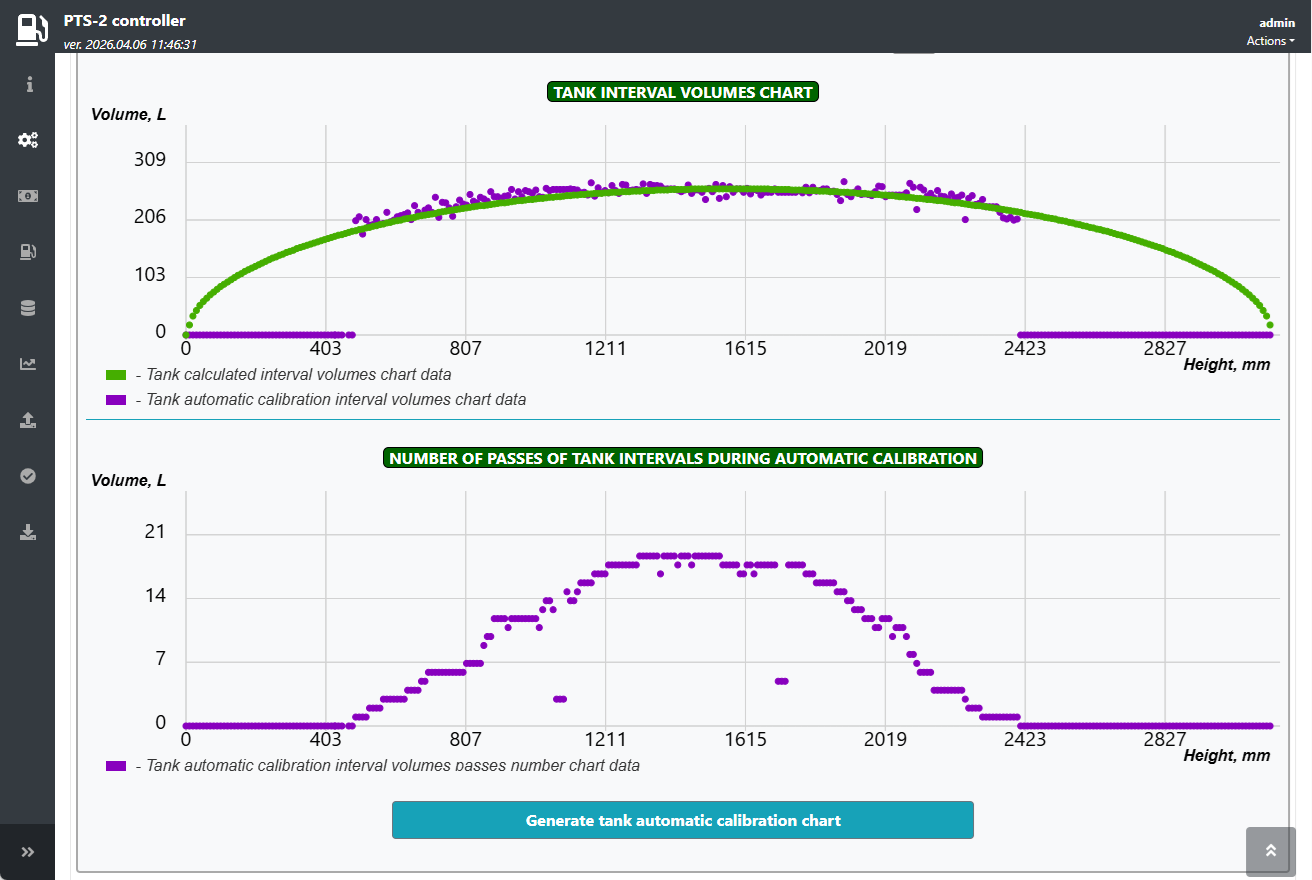
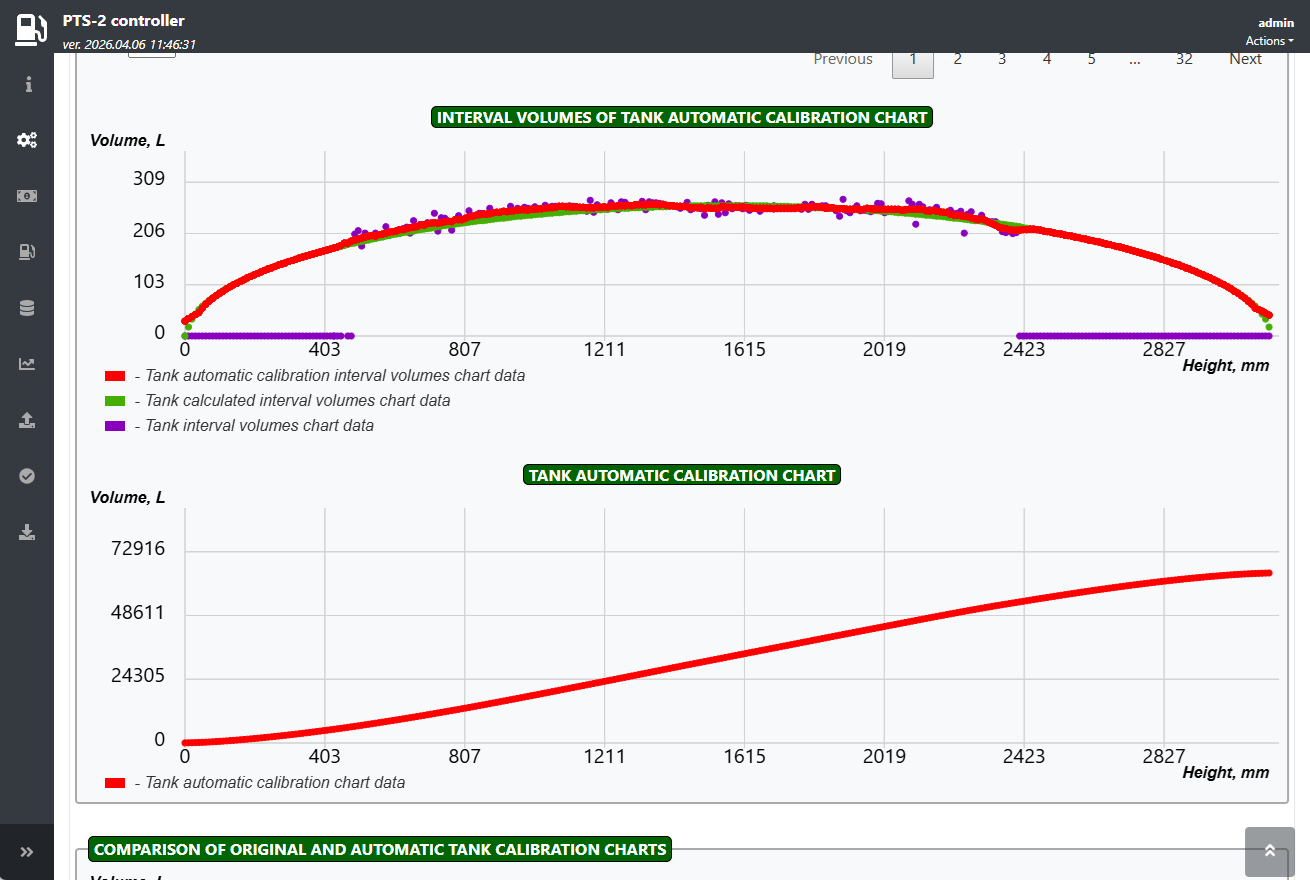
Calculation and formation of tank calibration charts is performed automatically during the system operation using results of measurement, received from the ATG probes installed inside the tanks and from the fuel dispensers, which fill the fuel. The system does not need any stoppage of the petrol station operation. The PTS-2 forecourt controller supports more than 200 brands of dispensers and ATG probes from various manufacturers.
To make autocalibration happened, your current station infrastructure should be enhanced with the PTS-2 forecourt controller. There is no need for you to change anything. PTS-2 forecourt controller can be installed between the existing forecourt controller (POS) and fuel dispensers and tank measurement system.